Tom Bolles
The Boys in the BoatTom Bolles was a former University of Washington oarsman who became its freshman coach, but his importance lay in more than producing fast boats: he had to teach young men who often arrived knowing almost nothing about rowing how to master a demanding sport and work as a crew. A history major pursuing a master’s degree, he brought a scholar’s appearance and an educator’s task to the shell house. His freshmen’s progress—from uncertain beginners to crews that could defeat California and compete for national honors—made him both a formative coach and a figure coveted by Harvard University.
Identity and Setting
A slim young man carrying a large megaphone, Bolles directed proceedings outside the shell house. He had a pleasant, somewhat lean face and wire-rimmed glasses; local sportswriters, noticing his distinctly scholarly appearance, began calling him “the professor.” The nickname suited the work ahead. While basketball and football prospects generally knew their games’ rudiments before college, almost none of the young men gathering for rowing understood its basics. Bolles’s role was therefore not simply to select talent. Each fall he had to turn novices into oarsmen.
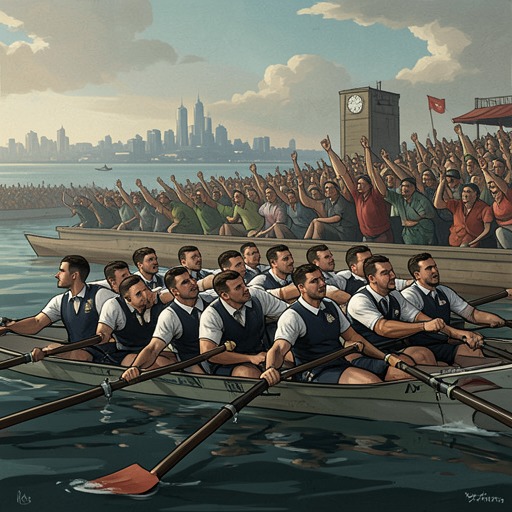
That work took place within a sport whose public standing was rising. In the 1920s and 1930s, collegiate crew attracted national press coverage and large audiences, while leading eastern universities drew on traditions that treated rowing as a gentleman’s sport. On the West Coast, the rivalry between the University of California, Berkeley and the University of Washington, dating to 1903, helped build a following of students, alumni, and local spectators. Yet western programs had fewer resources than their eastern counterparts, and the coaches were paid much less. Bolles coached within that uneven landscape, where a freshman victory could carry significance beyond the race itself.
Teaching and Daily Discipline
For Joe Rantz and the other freshmen, practice began with a daily routine. After classes, they made the long walk to the shell house, changed into jerseys and shorts, weighed in, checked a chalkboard for that day’s crew assignment, and gathered on the wooden ramp to hear Bolles. The weigh-ins served two purposes: they made each rower consider whether his weight justified the power he contributed, and helped staff ensure that training was not driving the boys below their optimal weight. Bolles’s talks, meanwhile, varied with the weather and the technical faults he had noticed in practice.
Two messages recurred. Rowing would test both body and character; only a small number of the freshmen would prove capable of earning a W on their chests, and Bolles warned that many would quit by Christmas break. At the same time, he held out the possibility that the experience could transform their lives and make them part of something larger than themselves. His teaching thus joined attrition to belonging: the warning that most would not last accompanied an invitation to persist and become a crew.
His attention to technique could be specific and persistent. In the spring, he moved Rantz between the number three and number seven seats while trying to correct a problem that did not yield to reassignment. Rantz struggled to “square up” his oar: rotate the blade until it stood perpendicular to the water just before the catch. A blade entering at the wrong angle weakened the power of the stroke and reduced the boat’s efficiency. The adjustment demanded strong wrists and fine motor control, and Bolles had not yet managed to make the movement consistent. The episode shows his concern with each individual action as part of the boat’s collective performance: a small technical fault could become a weakness for the whole crew.
Bolles also enforced the practical demands of rowing beyond the stroke itself. One warm day in early May, some freshmen rowed so lethargically that they failed to cross ahead of a tug pulling a barge. As the vessel bore down on their shell, its whistle shrieking and black smoke pouring out, the coxswain called for them to back. The rower in the number four seat panicked and jumped overboard, nearly capsizing the boat. The tug swerved, grazed the shell’s bow, and narrowly missed the boy in the water. Watching from his launch, Bolles retrieved the red-faced rower and hurried back to the shell house. The near collision turned an ordinary practice into a stark demonstration that a crew’s inattention could endanger both its boat and its members.
Developing Competitive Freshmen
Bolles’s confidence was tested against California, whose freshman coach, Ky Ebright, had given his rowers a head start. Ebright’s boys had been rowing since late August and practicing in real shells since late October, while Washington’s freshmen had only tentatively begun in shell barges. Bolles knew the California crew was reputed to be strong and heard Ebright boasting in the Bay Area press. He answered with a six-day-a-week schedule, rain or shine, and an insistence that his freshmen would not be the first crew he had coached to lose on Lake Washington.
A two-mile time trial offered evidence that the boat was coming together. Bolles checked the stopwatch, then looked again: the time suggested that his freshmen had the makings of an exceptional crew. He kept the result to himself, however, because California’s strength remained unknown and their contest was still a week away. His private reading of the time was a measure of both optimism and restraint: the stopwatch could tell him what Washington had done, not what its rival might do.
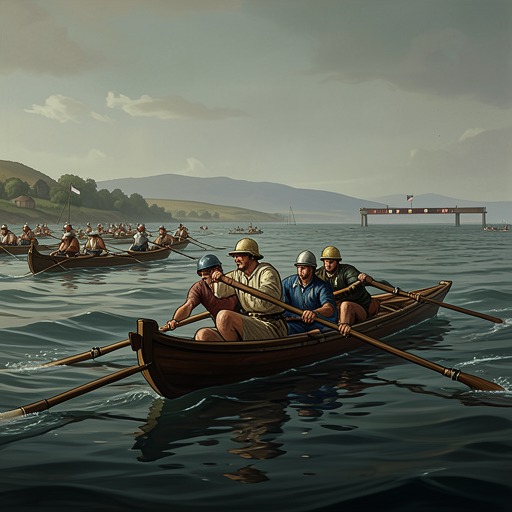
In late May, the first boat produced a more public measure of its ability. Rowing into a sharp north wind, with spray flying from the oars and water sloshing in the hull, the freshmen completed a time trial in 10 minutes 35 seconds, only four seconds off the course record. George Pocock watched from the Alumnus and, back ashore, gave the boat a rare endorsement: “Tom Bolles has a fine rough-water boat,” he said. “It is as good as any I have seen.” Pocock’s judgment mattered because he was reserved and not given to exaggerating a freshman crew’s ability. After hearing it, Bolles stopped talking about rebuilding the crew from scratch. The nine freshmen who had beaten California would go to Poughkeepsie after all, to race for the national championship.
At the Poughkeepsie regatta, Bolles’s attention extended to the details around the starting line. As the freshman boats approached their stake boats, he wore his good-luck fedora and called final instructions to coxswain George Morry. Washington started in lane three beside Syracuse, whose freshmen were defending champions and favorites after winning three of the previous four titles. When the Washington boys prevailed, they shook hands with their opponents and collected the trophy shirts from the defeated crew. Back at the shell house, they carried out the customary celebration by throwing Morry into the Hudson. The victory made Bolles’s instructional work visible in the result: a boat developed from novice rowers had defeated a highly regarded champion.
Ambition, Recognition, and Departure
Bolles’s record gave him standing beyond the freshman program. When Harvard’s head coach, Charlie Whiteside, was fired, talk arose that Bolles might succeed him, particularly if he won another freshman race at Poughkeepsie. Bolles knew Harvard was prepared to pay handsomely for a head coach, and he understood that he was again near the top of its list. As his crew’s train began to back up, he considered that if his boys came through for him once more, he would probably accept an offer.
They did come through. In the rain, shortly before four in the afternoon, Bolles’s freshmen paddled upriver to their starting position between Columbia and California. His battered good-luck hat was dripping at the brim. The crew stayed close early, then lengthened its advantage; by the final hundred yards, Bolles was waving the soggy hat in the press car as Washington crossed the line four lengths ahead of California. The race confirmed the promise he had seen in his freshmen, and the narrative records the double consequence plainly: Washington won, but lost Bolles.
The fedora recurred as a marker of his presence at the decisive instant. He had started wearing the hat on race days in 1930 and had not lost a race while wearing it; at Poughkeepsie, the same battered object became soaked as the crew he had prepared secured its victory. The detail links ritual and record without making the hat a substitute for the work behind the result. His achievements rested on instruction, repeated technical correction, daily discipline, and crews tested against formidable rivals.
Place in the Story
Bolles’s career illuminates the particular importance of freshman coaching: he worked with rowers before their abilities could be reliably judged against a major rival, then had to make their competence in the boat legible through racing. His regular Lake Washington record, the risk of California’s head start, the difficult rough-water time trial, and the Poughkeepsie wins trace that progression from promise to proof. The coaching itself ranged from weighing and seat assignments to the fine mechanics of the catch and the shared discipline required to keep a shell safe.
His story also sits within a broader contest over who could claim authority in American rowing. Eastern programs drew on longstanding prestige and greater resources; western crews, often working without wealthy patrons, had to earn recognition through competition. Bolles’s freshmen gave Washington a way to challenge that hierarchy, while Harvard’s interest showed that the coach’s success could carry him toward an institution at its center. His departure, as presented through the victory that coincided with losing him, makes the achievement bittersweet: the crew’s result affirmed the value of his teaching, but also marked the end of his work for Washington.